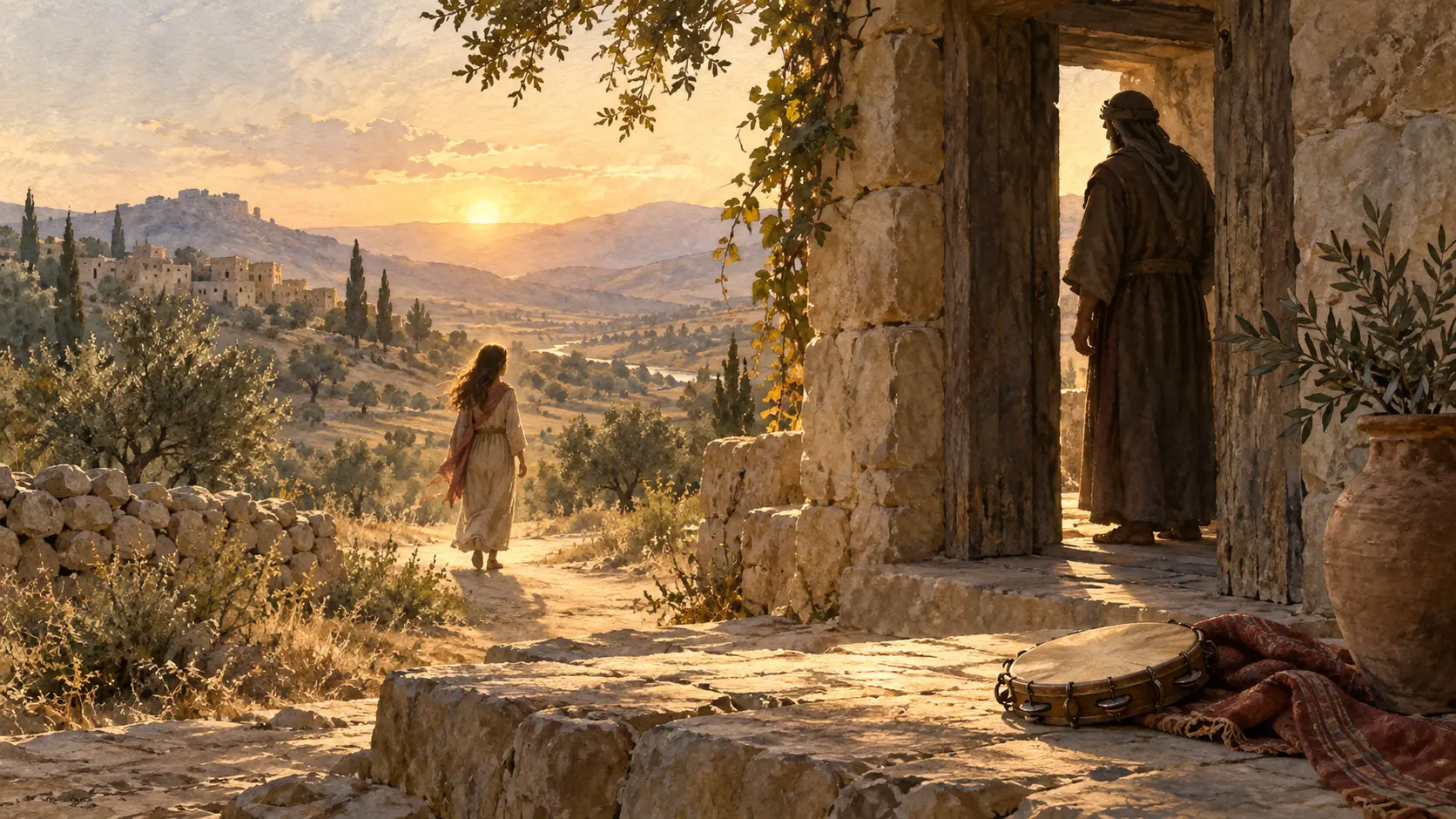
Noa’s Innocence
O blameless daughter, you went out to meet him, a tambourine in your hand, laughter still upon your lips. Beneath your feet, the dust rose as it does when victory comes home.
You knew nothing of the vow. You did not know that words spoken far from you would weigh upon your life. You had promised nothing. Yet you would have to answer for them.
Your father saw you coming. What he had expected from victory broke upon his own threshold.
You heard his anguish, then asked for time: two months with your companions, upon the mountains, to mourn the life that would not be yours.
Innocent, you became a memory. Every year, the daughters of Israel remembered you. We do not know your name in the Book; here, we call you Noa so we can speak to you directly.
We still hear your tambourine at the threshold of that house. The joy with which you came makes all the graver the words that waited for you.
The Weight of Jephthah’s Vow
O Jephthah, your brothers drove you away. Later, the elders came looking for you: they needed the one they had allowed to leave.
You asked them what your place would be. You knew the price of human promises. Yet on the road to battle, you spoke before God a promise whose reach you had not measured.
Why that vow? The story does not open your heart to us. We sense fear there, perhaps, or the desire to hold victory in your hands.
Then your daughter came out. She knew nothing. You already knew too much.
Your words rose up between you. You spoke to her of your misfortune; she asked you for time. Only two months. After that, she returned.
Jephthah, your victory remains in the Book, but it is your vow that we also reread. It compels us to ask what a spoken word can destroy when honor keeps us from questioning it.
You were a father before his daughter, a man before what he had said. She had left the house with a tambourine; the daughters of Israel kept her memory.
These are the two mirrors: a daughter returning without knowing the vow, a father waiting with the knowledge of what he has promised. Between them remains a question the story does not resolve for us: what should we do when a promise threatens an innocent life?
Reading note. Noa is the name given to Jephthah’s daughter in this poetic interpretation; the biblical account does not name her. Inspired by Judges 11:29–40.
Return to the poems →