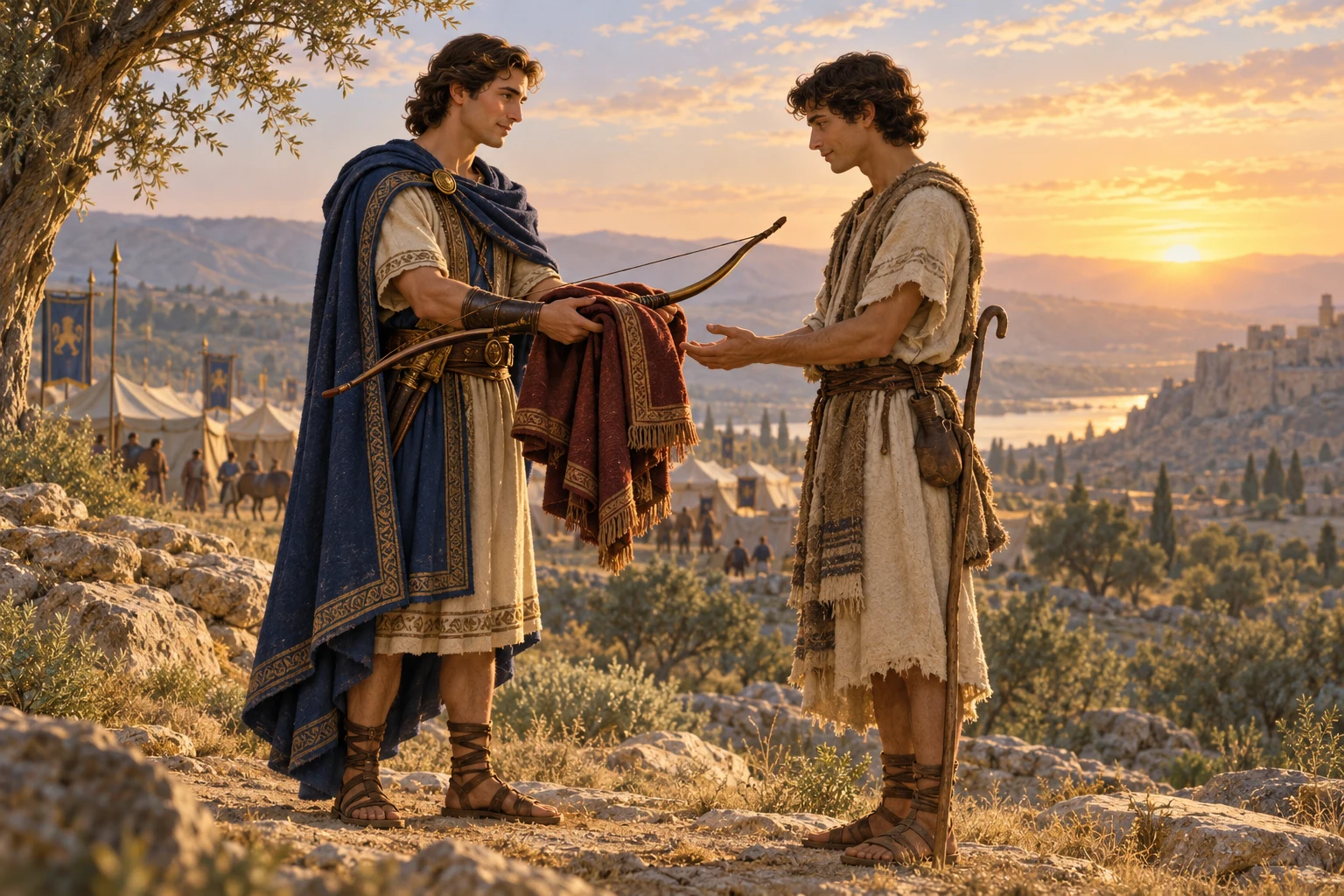
The Prince and the Shepherd
Jonathan, you were a king’s son, heir to a name, an army, a place prepared before your birth.
David, you came from the hills with the scent of the flocks, the dust of the roads, and a few songs kept in your heart.
Everything should have kept you apart.
One had grown up near the throne; the other had been overlooked behind his older brothers.
One carried a prince’s sword, the other a shepherd’s sling.
One seemed destined to reign; the other had received, in secret, a promise that threatened this future.
By every measure, you should have become rivals— two men convinced that one man’s light must dim the other’s.
Fear could have taught you to count your victories, measure your strength, and watch each other from a distance.
Yet beneath all that separated you, you recognized the same courage, the same faith when others drew back, the same desire to serve without asking who would receive the honor.
Your souls recognized one another before your interests had time to collide.
And friendship was born.
Two Giants of Generosity
Jonathan, you could have guarded your rank and treated David as the man who had come to take what birth had promised you.
Instead, you placed your robe upon his shoulders.
You gave him your sword, your bow, and your belt.
You offered more than your hands could hold: you opened a place for him within your future.
You watched the man grow who might one day become king in your place, yet you did not try to dim his light.
You did not ask him to remain small so that you could remain great.
You gave without turning your gift into a debt.
David, you received Jonathan’s covenant without reaching for his crown.
You did not make his friendship an instrument of your ambition.
When Saul’s anger turned murderous, three arrows crossed a field, carrying a warning no servant was meant to understand.
Then, when the field was empty, the prince and the fugitive embraced.
You wept together, knowing that the road before you would no longer be shared.
The arrows had spoken. The kingdom had divided you. Friendship had not.
When Jonathan fell, David, you did not celebrate the passing of an heir.
You mourned a brother.
The road to the throne was open at last, but your eyes did not see the crown.
They searched for an absent face.
Years later, when the battles had quieted and the throne was finally yours, you asked whether anyone remained of Jonathan’s house.
And Mephibosheth— wounded in both feet, expecting judgment— was given a place at your table.
Jonathan’s seat was empty, but his name had not been forgotten.
You were two warriors, yet your greatest victory was won neither by sword nor bow.
It was won within— where envy might have risen, where ambition might have spoken, where fear might have changed a friend into a rival.
Goliath was not the only giant defeated.
You overcame the ancient fear that another person’s greatness must diminish your own.
You refused to let power decide how you would love each other.
What Can Unite Us
We readily notice what distinguishes us:
name, origin, position, old wounds.
Another person’s success can feel like a shadow falling across our own path.
Then encouragement grows cautious. Generosity begins to calculate. Love quietly waits to be repaid.
David and Jonathan show us another way.
Jonathan’s robe upon David’s shoulders,
the arrows crossing the field,
David’s table prepared for a wounded son—
these are the signs of a friendship that refused to become rivalry.
Such friendship rejoices when another person’s gift appears.
It protects without possessing and gives without keeping account.
The world may overlook this courage because it wins no kingdom and raises no monument.
Yet it is a rare victory:
to recognize another’s calling without fearing for our own,
to hold power without using it to diminish,
to remember a friend after grief and distance have changed everything.
Christ calls us into this same freedom.
He teaches us to ask what our presence might awaken in another person’s life.
He forms us into people capable of friendship— people who can extend a robe, a warning, a place at the table, and a faithful memory.
Love in the way of Christ does not stand alone at the summit.
It walks toward the other with open hands.
Prayer
Lord, teach us to recognize, beyond what separates us, what can still draw us together.
Free us from the fear that another person’s light will diminish our own.
Give us hearts able to encourage freely, to serve without controlling, and to love without keeping account.
In a world quick to turn difference into rivalry, teach us to build friendships that seek neither the throne nor applause, but the good of the other.
Amen.
Then our bonds will become stronger than self-interest, stronger than fear, stronger than power—even stronger than the throne.
Reading note. Inspired by 1 Samuel 18:1–4; 20; 23:16–18; 2 Samuel 1:17–27; and 2 Samuel 9.
Return to the poems →